Identify the missing function
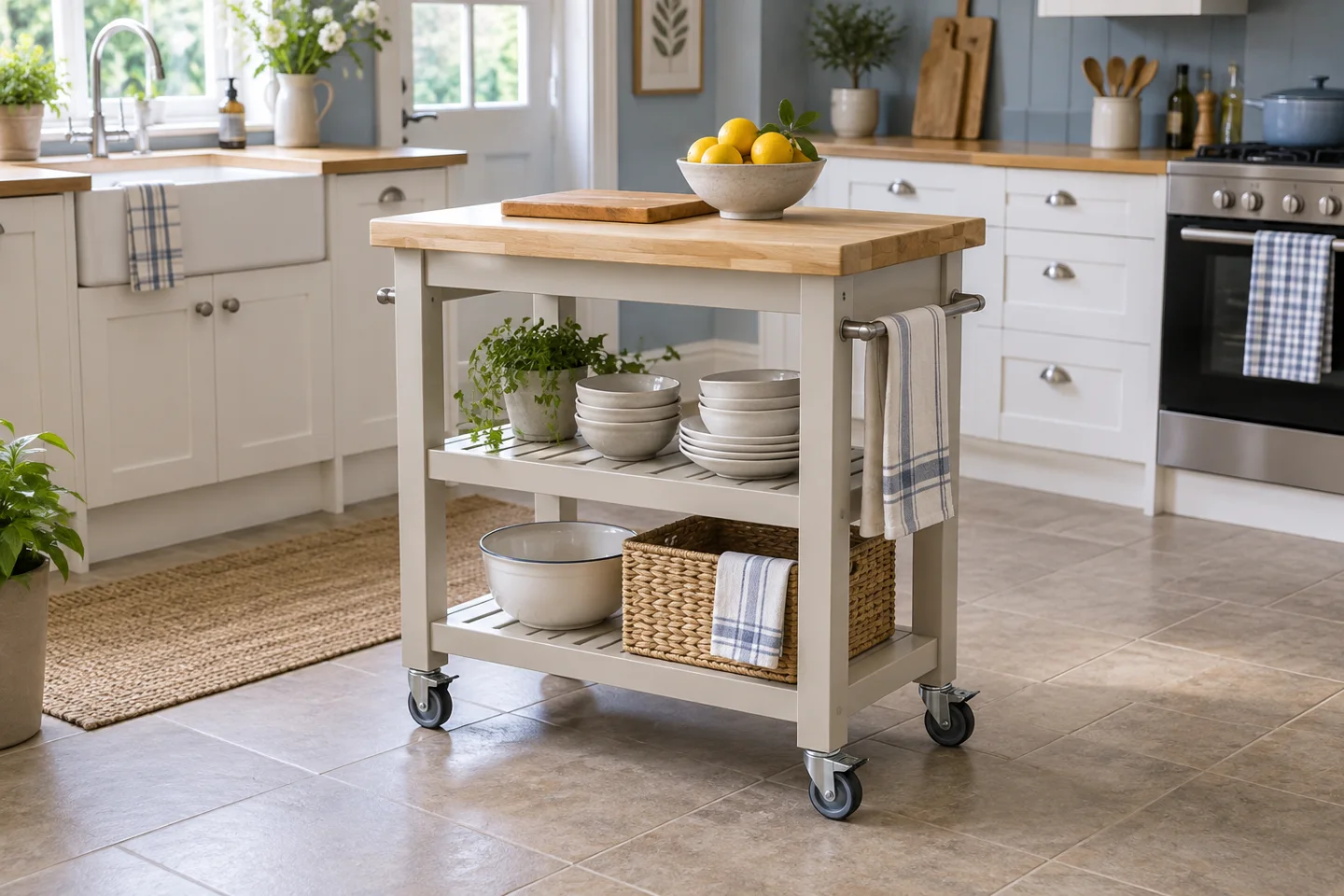
A kitchen trolley can hold baking equipment, provide a serving surface or keep frequently used items together. It is less helpful when bought as an undefined place for overflow. Describe the task you want it to perform and list the objects involved. That gives you a basis for comparing shelf heights, top size and storage details.
Look for a simpler solution first. An existing cupboard rearrangement may provide the needed space without adding furniture to the floor. If the trolley still solves a real problem, mark its intended position. It should improve the kitchen's use rather than make a narrow route more complicated in exchange for a few extra shelves.
Measure both parking and working space
Record the trolley's full dimensions, including handles, rails and projecting wheels. Check the route past it with cupboard doors and appliances open. A piece that parks neatly beside a wall may still obstruct cooking if it needs to move into the centre for use. Test that working position as carefully as the storage position.
If the trolley will move between rooms, inspect thresholds and floor changes along the route. Consider the filled weight and whether moving it is comfortable. Do not assume wheels make any load easy to control. Follow the manufacturer's guidance on surfaces, movement and load limits, particularly where a trolley carries fragile or heavy items.
Examine the top surface
A serving trolley and a food-preparation surface may have different specifications. Check whether the top is suitable for the intended task and what protection it requires. Use appropriate chopping boards, trivets or other protection rather than assuming a timber-looking top tolerates cutting, heat or standing water. Material appearance alone does not establish its performance.
Compare the top height with the work you plan to do. A low surface may suit serving but feel awkward for sustained preparation. If the trolley will support an appliance, confirm that the furniture and appliance instructions permit the arrangement, including ventilation, stability and electrical supply. Do not create a trailing cable route across the kitchen for convenience.
Check the wheels and stability
Look at how the wheels lock and whether the trolley remains secure in its intended working state. Follow instructions for assembly and use rather than relying on an informal push test alone. Handles should help control movement without encouraging an unsuitable load. A trolley is not a seat, step or support to lean heavily on unless explicitly designed for that purpose.
Avoid loading shelves so that items can fall during movement. Taller bottles and stacked dishes need appropriate containment and spacing. Keep heavy contents positioned according to the product guidance. If the trolley must be emptied before it can be moved safely, reconsider whether mobility is actually a useful feature for this task.
Make the storage accessible
Check internal shelf heights and whether baskets or drawers open comfortably in the parked position. Store only the items assigned to the trolley's role, leaving some spare room for returning them. Open shelves near cooking may need frequent cleaning, so choose contents and surfaces you can maintain easily. A successful trolley becomes a clear, useful part of the kitchen routine rather than a mobile collection of everything that lacked a cupboard.
Choose the trolley for its working position, contents and movement, not simply for extra storage.
A Swishover guide · Practical ideas to adapt to your own home.
Spotted something we should improve?