Read the balcony as a whole space
Measure the usable floor and note the door swing, drainage points and any fixed equipment. The balcony must remain accessible, with required routes and openings clear. Check building, tenancy or management rules before buying furniture, including restrictions that affect storage or use. Do not guess at structural capacity; seek appropriate confirmation if there is uncertainty about permitted loads.
Mark the proposed seats on the floor and include room for legs and getting up. A chair's dimensions when folded or tucked under a table do not describe its occupied footprint. Test the arrangement with the number of people who will normally use it. One comfortable seat may be more useful than a crowded set that leaves no room to move.
Consider wind and exposure
Outdoor furniture needs to suit the conditions of the particular balcony. Strong sun, rain and wind can affect materials and how items must be stored or secured. Follow the product and building guidance rather than improvising attachments to railings. Lightweight furniture may be easy to move but needs a sensible plan when weather makes leaving it outside unsuitable.
Respect the balcony edge
Keep furniture and accessories away from positions that could encourage climbing near the edge, especially where children are present. Avoid anything projecting beyond the balcony boundary. Safety and the building's requirements should shape the arrangement before appearance. A small outdoor space can still feel inviting without filling every corner.
Try the seat and its movement
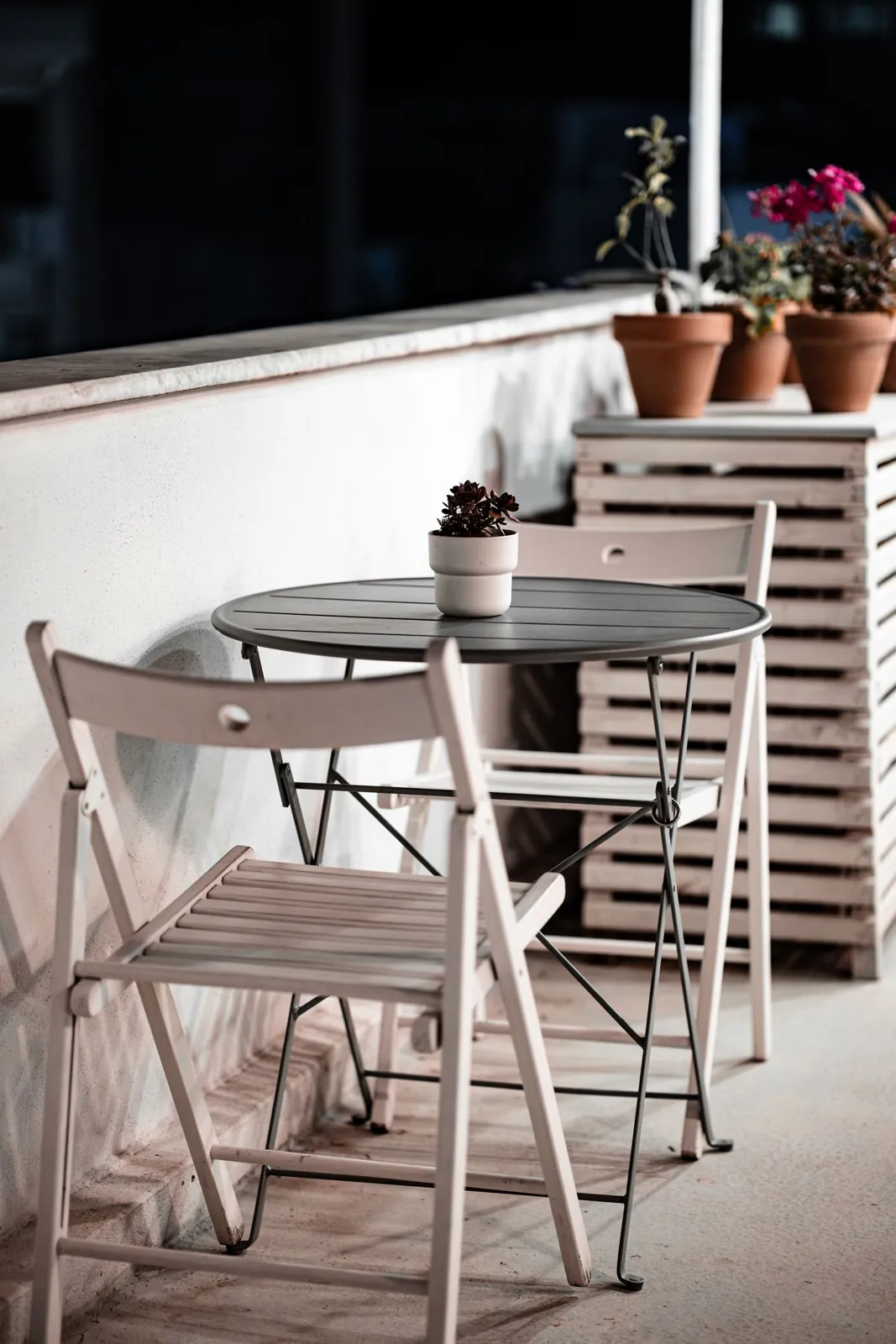
Check seat height, back support and how comfortably you can stand up. Folding designs may save space, but inspect the locking mechanism and follow instructions to avoid pinch points or accidental folding. A compact chair should feel secure in its open working position. If it needs a cushion, include that cushion's storage and care in the decision.
Look at the feet in relation to the balcony floor. They should sit appropriately without damaging the surface or blocking drainage. Do not assume every outdoor chair suits every deck or tiled finish. Ask the supplier about suitable use and protective details where needed, especially if the floor has a delicate coating.
Decide whether a table is necessary
A small stable surface for a drink may be enough. Include its footprint and the reach from the chair in your test. Avoid improvised rail-mounted or hanging arrangements unless they are designed, permitted and correctly installed for that exact situation. The balcony should remain straightforward to enter and leave while the furniture is being used.
If a folding table is useful, check where it goes when closed. Storage should not obstruct the door or require balancing it precariously. A combined set can look convenient online but may use more floor space than separately chosen pieces. Compare the actual dimensions rather than assuming the set was designed for a balcony as small as yours.
Plan care before ordering
Read material and cushion care guidance, including whether covers are required and what must be stored indoors. Confirm there is a suitable place for those items. Check delivery access through the home as well. The right seating will be something you can use comfortably, protect appropriately and move without difficulty, leaving the balcony pleasant through changing conditions rather than only on the day it is arranged.
Comfortable outdoor seating needs usable movement space and a storage plan for unsuitable weather.
A Swishover guide · Practical ideas to adapt to your own home.
Spotted something we should improve?